
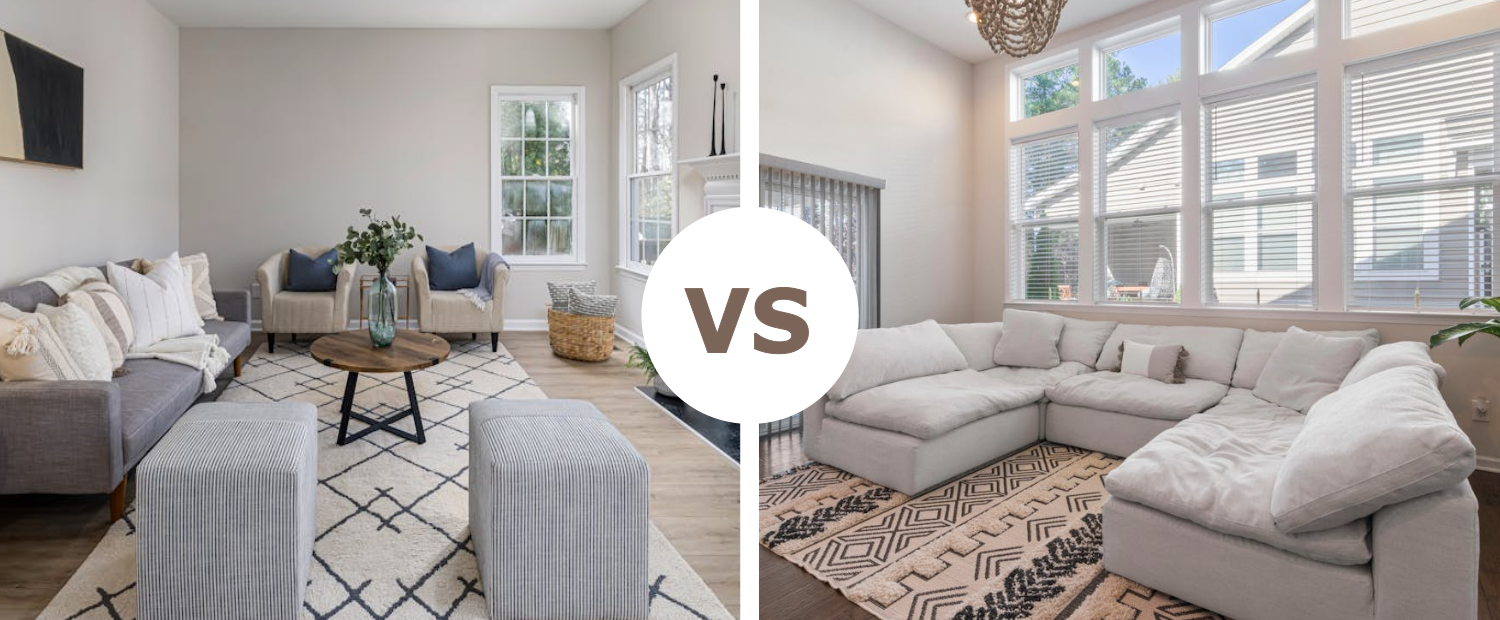

Compare Sectional vs. Sofa and Love Seat

Choosing living room seating sounds simple until you’re standing in an empty space trying to imagine how everything will function. Should you commit to a spacious sectional, or would a traditional sofa and loveseat offer more flexibility?
It’s one of the most common living room design decisions homeowners will face, and the answer isn’t always straightforward or obvious.
When comparing a sectional vs sofa and loveseat, it’s easy to focus solely on appearance. But the best choice goes far beyond aesthetics. The right seating layout influences how people move throughout the room, how comfortably you entertain guests, how well the space adapts to future needs, and even how large or small the room feels.
Both options can create beautiful, welcoming living rooms. A sectional provides maximum seating and a cozy, gathered feel, while a sofa and loveseat can offer greater versatility and balance. Understanding how each layout performs in different situations makes it easier to choose one with confidence.
In this guide, we’ll compare seating capacity, traffic flow, functionality, flexibility, and more so you can determine whether a sectional or a sofa and loveseat arrangement will work best for your home.
Sectional vs Sofa: Fundamental Differences

Before evaluating specific living room layouts, it’s helpful to understand what separates these two seating approaches.
A sectional combines multiple connected seating sections into one large piece of furniture. Most configurations include an L-shape, though U-shaped and modular designs are also common.
A traditional sofa and loveseat arrangement uses separate furniture pieces that can be positioned independently throughout the room.
Why Choose a Sectional?

Sectionals create a unified seating zone that naturally encourages people to gather together, making them a popular choice for family rooms and casual living spaces. Because all of the seating is integrated into a single furniture piece, sectionals often provide more seating capacity than a traditional sofa and loveseat arrangement.
Many designs also include a built-in chaise or extended lounging section, creating a comfortable spot for relaxing, reading, or watching television.
From a design perspective, a sectional can serve as a strong focal point that helps define the room’s layout and establish a clear seating area. Many homeowners appreciate how a sectional instantly gives a living room a cozy, welcoming, and family-friendly feel.
Pros of a Sectional
- Provides ample seating for families and guests
- Makes efficient use of available floor space
- Often includes chaise or lounge seating for added comfort
- Creates a cohesive, unified seating arrangement
- Helps define the living room layout, especially in open-concept spaces
- Reduces the need for multiple seating pieces
Cons of a Sectional
- Less flexible than separate seating pieces
- May overwhelm smaller spaces if not properly sized
- Limits the ability to create multiple conversation areas
- Often costs more than a standard sofa
- May restrict traffic flow in narrow or awkwardly shaped rooms
Why Choose a Sofa and Loveseat?

A sofa and loveseat combination offers a more flexible approach to living room seating than a sectional. Because each piece stands independently, homeowners have greater freedom to arrange, rearrange, and adapt the layout as their needs change.
This flexibility can be especially valuable when moving to a new home, redesigning a room, or accommodating changing family dynamics.
A sofa and loveseat setup also creates more opportunities for customized furniture arrangements, making it easier to balance the room, preserve traffic flow, and create dedicated conversation areas. Visually, separate seating pieces often feel lighter and less imposing than a large sectional, which can help a living room appear more open and spacious.
Because each piece stands independently, you can adjust the arrangement as your needs change over time.
Pros of a Sofa and Loveseat
- Offers greater flexibility for furniture arrangement and layout
- Easier to adapt when moving to a new home
- Creates more opportunities for conversation-focused seating
- Maintains a lighter, more open visual appearance
- Allows homeowners to update or replace individual pieces as needed
- Works well in a wide variety of room sizes and floor plans
- Can improve traffic flow by allowing more customized placement
- Easier to incorporate accent chairs or additional seating
Cons of a Sofa and Loveseat
- Typically provides less seating than a comparable sectional
- May require additional chairs for large gatherings
- Can create a less cohesive look if pieces are not well coordinated
- May not feel as cozy or lounge-friendly as a sectional
- Requires more planning to create a unified arrangement
- Can result in a fragmented layout if pieces are poorly positioned
The sofa vs sectional debate begins with understanding how each layout functions. Sectionals create a cohesive seating zone, while sofa and loveseat combinations offer greater flexibility and adaptability. Neither option is inherently better— the right choice depends on how you use your living room.
Sectional vs Sofa for Different Room Sizes

Although functionality is certainly a primary concern, room size is often the deciding factor when comparing sectional vs sofa layouts.
Contrary to popular belief, larger rooms don’t automatically require sectionals, and smaller rooms don’t always rule them out.
Small Living Rooms
In small living rooms, every inch matters. While many people assume a sectional is automatically too large for a compact space, that’s not always the case.
A well-proportioned apartment-size sectional can sometimes provide more seating than a sofa and loveseat without requiring additional furniture pieces. However, oversized sectionals often dominate small rooms, making them feel cramped and restricting traffic flow.
VERDICT: In most small living rooms, a sofa and loveseat or accent chair is the safer choice because it creates a lighter, more open feel and offers greater flexibility. Consider a smaller-scale sectional only if you need to maximize seating and can maintain comfortable walkways around the furniture.
Medium-Sized Living Rooms
Medium-sized living rooms offer the greatest flexibility when choosing between a sectional and separate seating pieces. Most layouts can comfortably accommodate either option, allowing homeowners to prioritize lifestyle preferences rather than space limitations. The decision often comes down to how the room is used on a daily basis.
VERDICT: Both options work well in medium-sized spaces. Choose a sectional if comfort, lounging, and family movie nights are priorities. Choose a sofa and loveseat if you prefer a more flexible layout, better conversation areas, or the ability to rearrange furniture over time.
Large Living Rooms
Large living rooms can easily absorb larger furniture pieces without feeling crowded. In fact, furniture that is too small often looks disconnected or undersized within a spacious room. Both sectionals and multiple seating pieces can work well, but they create very different experiences.
VERDICT: A sectional is often the better choice for creating a defined seating zone in a large room, particularly in open-concept layouts. However, a sofa and loveseat arrangement may be preferable if you frequently entertain and want to create multiple conversation areas or a more formal, balanced design.
Open-Concept Living Rooms
Open-concept spaces introduce another layer of complexity because furniture often serves as a divider between living, dining, and kitchen areas. In these layouts, seating does more than provide comfort—it helps establish structure.
VERDICT: A sectional is usually the strongest choice for open-concept homes because it helps define the living room and creates clear boundaries within a larger space. Choose a sofa and loveseat instead if you want a lighter visual footprint or anticipate changing the room layout in the future.
Capacity vs Comfort & Conversation

Everyday use is where the sofa vs sectional decision becomes most personal. It’s not just about how many people can physically fit in the room— it’s about how those seats feel to use on a daily basis. Some layouts prioritize maximum lounging space, while others create more balanced conversation areas where guests naturally face one another.
Understanding this tradeoff helps you choose a layout that supports both everyday living and the way you actually entertain.
Seating Capacity with a Sectional
One of the biggest advantages of a sectional is straightforward: it typically seats more people in a single, continuous arrangement.
Instead of relying on multiple separate pieces, a sectional consolidates seating into one cohesive footprint, which often makes it feel more efficient in casual, high-use spaces.
This is especially useful for families or households that regularly gather in the living room. A sectional naturally supports shared lounging— people can stretch out, sit comfortably, or shift positions without needing to grab extra chairs. Many designs also include chaise seating, which adds an informal “relaxation zone” that becomes the most used spot in the room.
However, the tradeoff is that seating is less defined. While it’s great for togetherness, it can feel less structured for formal conversation or when hosting guests who don’t know each other well.
Personal Conversations with a Sofa and Loveseat
A sofa and loveseat arrangement offers a different kind of comfort— one that’s more structured and conversational. Instead of one continuous seating zone, you get distinct places for people to sit, which naturally encourages better face-to-face interaction.
This setup often works beautifully for households that value entertaining or prefer a more intentional living room layout. Guests are less likely to cluster in one corner, and seating feels more balanced and evenly distributed throughout the space.
In terms of everyday use, the experience can feel slightly more formal than a sectional, but also more adaptable. People have their own defined space, and the room tends to support conversation as much as lounging.
Effect on Traffic Flow: Sofa vs Sectional

Another important factor to consider in the sofa vs sectional decision is traffic flow. Even the most beautiful space can become frustrating if people are constantly squeezing past furniture or cutting through seating areas.
Traffic flow is the way people move through your living room day to day— entering, exiting, and navigating between zones. And your choice between a sectional vs sofa plays a major role in whether that movement feels natural or constrained.
When evaluating a sectional vs sofa, ask yourself:
- Do people walk through the room to reach another space?
- Are there multiple entry points?
- Do kids or pets move through the space frequently?
- Is the living room part of an open floor plan?
If the answer to any of these is yes, your furniture layout needs to support traffic flow first, style second.
How Sectionals Influence Traffic Flow
Although a sectional may block pathways, they can actually simplify circulation when used correctly. Because a sectional consolidates seating into one connected footprint, they can reduce the number of furniture edges people have to navigate around.
In the right layout, a sectional can:
- Clearly define the boundary of the seating area
- Keep walkways predictable and consistent
- Anchor the room so movement happens around it naturally
This is especially effective in open-concept homes where a sectional can act almost like a soft divider between living and dining zones.
However, the key word here is scale. When a sectional is too large for the room, it stops helping and starts interfering.
How a Sofa and Loveseat Improve Flexibility
A sofa and loveseat arrangement offers a very different kind of control over traffic flow. Because each piece is independent, you can shape the layout around the way people actually move through the room.
This flexibility allows you to:
- Preserve clear walking paths through the space
- Shift furniture slightly to open up tighter areas
- Angle seating to improve flow without redesigning the entire room
- Add or remove pieces (like accent chairs) without disrupting circulation
This makes sofa-based layouts especially effective in living rooms that aren’t perfectly symmetrical or have multiple access points. It also creates more “breathing room” visually.
Which Seating Layout Works Best

Which option works best? There’s no wrong choice here— only the one that best reflects how you actually live.
A sectional may be the perfect solution if your household prioritizes lounging, movie nights, family gatherings, and maximizing seating within a defined space.
A sofa and loveseat arrangement may be the better choice if flexibility, entertaining, future adaptability, and balanced conversation areas matter most.
The truth is that there is no universal winner in the sectional vs sofa debate. Both layouts can create beautiful, functional living rooms when chosen thoughtfully.
As you evaluate your options, focus on how the room functions every day rather than how it looks in a showroom. Consider your room size, traffic patterns, entertaining habits, household needs, and long-term plans. The most successful living rooms aren’t built around trends— they’re built around the people who use them.


